

Automate your status page with the API
Orbis Status does not watch your systems, but your own tools do. Connect them with the REST API so the page updates without anyone typing.
Why manual updates can lag
If a person has to notice a fault, log in and type, the page is always a few minutes behind.
- Your monitoring spots a fault at 3am, but the page says everything is fine until someone wakes up.
- The team has a runbook that includes "update the status page", and it is the step most often skipped.
- Other systems need to know about incidents but have no clean way to hear about them.
- Component status is copied by hand from one place to another.

What you can do with the API
You write the connection, using your own monitoring tool or a small script. There are no one-click integrations.
REST API with API keys
Read and set component status, and create and update incidents, using keys you create in your account. See the developer tools.
Signed webhooks
Get a call on incident and component changes, signed with HMAC SHA-256 so you can check it came from us.
Public status.json
Read the current status of your page as JSON from a public address, with no key needed.
Atom feed
Follow incidents in any feed reader, or pipe the feed into your own tools.
SVG status badge
Embed a live badge on your website or in a readme.
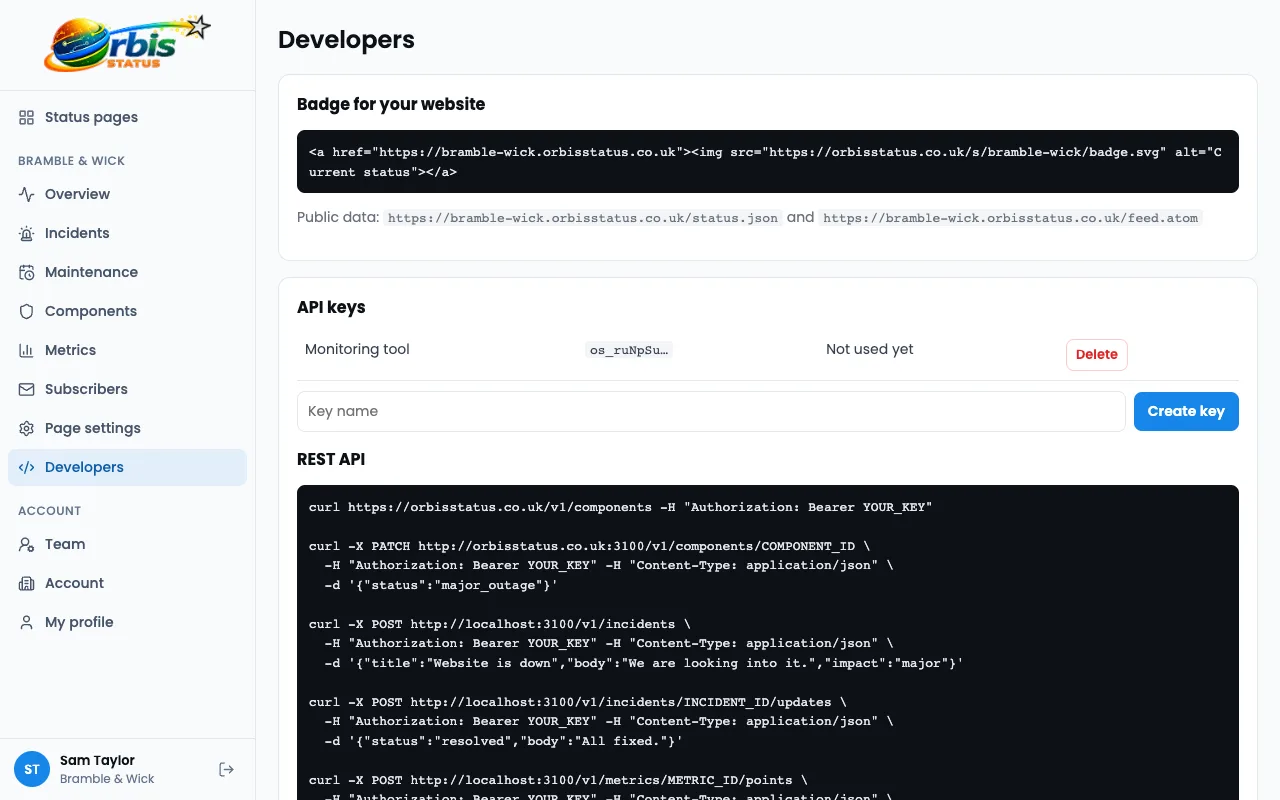
Worked example: a monitoring script
A fictional software team, Brightloop, already runs its own health checks and wants the page to follow them.
Create an API key
An admin makes a key in the developer settings and stores it with the other secrets.
The check calls the API
When the health check fails twice running, the script sets the API component to Partial outage.
A person adds the words
The on-call engineer opens an incident to explain it, because customers want a human explanation.
Webhooks tell other systems
A signed webhook calls a small script of theirs, which passes the change on to the rest of their internal tools.
This is an illustration of how the features fit together, not a real customer story.
Frequently asked questions
Does Orbis Status connect to monitoring tools?
There are no one-click integrations with named tools. Any tool that can make a web request can call the REST API or send a webhook to a small script of yours.
Does it do uptime checks?
No. Orbis Status does not check your systems. Your own tool does the checking and then tells the page.
Is the API on the free plan?
Yes. The REST API is on every plan, including Free. Outgoing signed webhooks start on the Startup plan.