

A status page that keeps customers informed
When something goes wrong, customers want a straight answer. Give them one public page that shows what is working, what is not and what you are doing about it.
Why customers fill the silence themselves
When there is no news, people assume the worst and go looking for someone to ask.
- A fault starts and customers only find out by hitting it themselves.
- Updates go out by email to some people, a social post to others and a phone call to a few.
- Nobody on the team is sure who is meant to say what, so nothing is said.
- After a fix, there is no record of what happened, so the same questions come back next time.

How Orbis Status keeps people in the picture
A public page at your-name.orbisstatus.co.uk, or your own domain, that your team updates in a couple of minutes.
A page with your branding
Add your logo, brand colour and links. Use your own your-name.orbisstatus.co.uk address or your own domain, both free on every plan. See the status page features.
Components and clear statuses
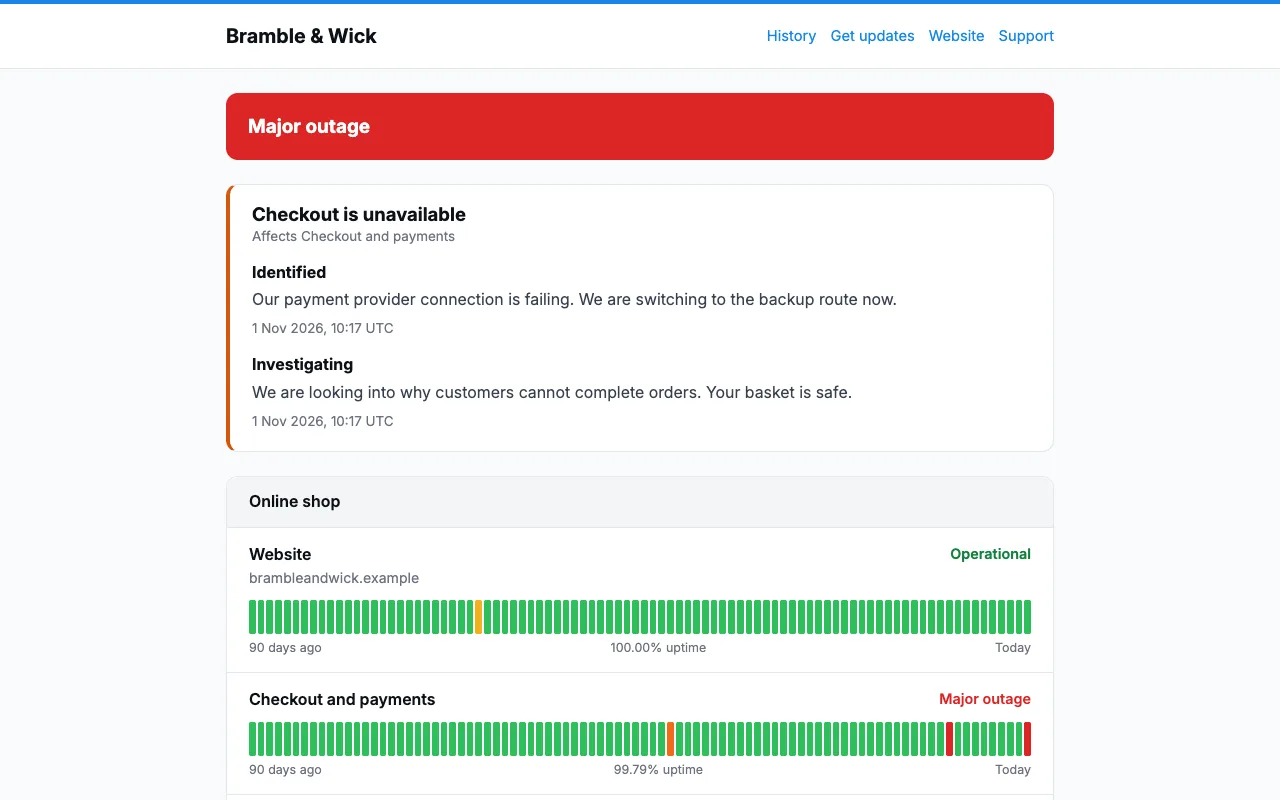
List the parts of your service that matter, then mark each as Operational, Degraded performance, Partial outage, Major outage or Under maintenance. See how components work.
90-day uptime bars
Each component shows a 90-day bar and a percentage, worked out from the status history you have recorded.
Email subscribers
Customers subscribe by email, confirm it, and hear about new incidents and maintenance without checking the page. Slack and Teams channels are covered too, and SMS is on paid plans that include it. See how subscribers work.
Incident history
Past incidents stay on a history page, so customers can see how problems were handled.
Worked example: a slow booking site
A fictional van hire firm, Marlow Vans, finds its online booking form is failing for some customers.
Someone on the team opens an incident
They choose the Booking site component, set it to Partial outage and post "Investigating".
Subscribers are told
Everyone subscribed by email gets the update, so fewer people try the form again and again.
The team posts progress
The status moves through Identified and Monitoring, each with a short plain note.
The fix is recorded
Resolving the incident puts the component back to Operational and leaves the full timeline on the history page.
This is an illustration of how the features fit together, not a real customer story.
Frequently asked questions
Does Orbis Status notice problems by itself?
No. It does not check your systems. Your team updates the page, or your own monitoring tool does it through the REST API or webhooks.
Does it cost anything?
The Free plan is £0 for each status page, with 100 subscribers, 2 team members and 25 components. Paid plans start at £11 per month, per status page, and remove the small "Powered by Orbis Status" link. Your subdomain and custom domain are free on every plan.
Can I keep the page private?
Yes. Private pages are for invited viewers who sign in with an emailed link, and start at £29 per month. Public pages can be read by anyone, so put nothing on one you would not want customers to read.